
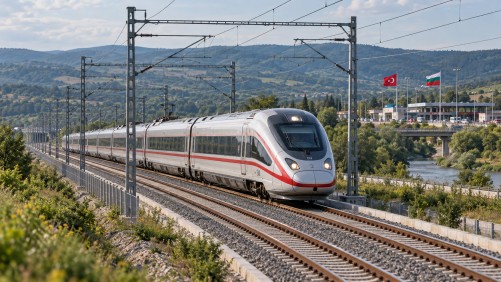
Türkiye has inaugurated a significant expansion of its high-speed rail network with the opening of a 153-kilometer section connecting Çerkezköy, near Istanbul, with Kapıkule on the Bulgarian border. This development extends the country’s railway closer to the European Union, as part of the longer 229-kilometer Halkalı-Kapıkule line. The line’s completion is anticipated to bolster Türkiye’s transport infrastructure, facilitating improved access to European markets and enhancing the country’s export capabilities.
President Recep Tayyip Erdoğan, who attended the opening ceremony in Kırklareli province with EU Enlargement Commissioner Marta Kos, emphasized the railway’s potential to boost production, employment, trade, and tourism. The new section integrates the provinces of Tekirdağ, Kırklareli, and Edirne into the high-speed railway network, increasing the total number of provinces served to 14.
The electrified, double-track railway, equipped with advanced signaling systems, enables trains to reach speeds of up to 200 kilometers per hour. This development is expected to significantly reduce travel times: passenger journeys between Halkalı and Kapıkule could decrease from four hours to approximately 1.5 hours, while freight transit times might fall from 8.5 hours to 3.5 hours. The railway is projected to increase annual passenger capacity from 600,000 to around three million, and freight capacity from 1.5 million to 9.5 million tonnes.
Türkiye’s Transport and Infrastructure Minister Abdulkadir Uraloğlu highlighted the project’s role in strengthening transport links between Türkiye and the European Union. The railway, co-financed by Türkiye and the EU, forms part of the Trans-European Transport Network and supports the Middle Corridor, a key trade route connecting Asia and Europe through Central Asia, the Caucasus, and Türkiye.
In addition to enhancing connections to European markets, the railway is set to improve links with industrial centers in Istanbul, Kocaeli, Tekirdağ, and the broader Thrace region, as well as nearby ports. The project includes new station buildings in Babaeski, Lüleburgaz, and Büyükkarıştıran, along with the reconstruction of the Kapıkule and Edirne stations.
Looking ahead, Türkiye plans to further expand its railway network, which currently spans 13,919 kilometers, including 7,274 kilometers of electrified lines. With construction underway on an additional 4,858 kilometers of railway, the country aims to grow its total railway network to 28,590 kilometers by 2053. This expansion is a strategic component of Türkiye’s long-term vision to enhance logistics, boost international trade, and strengthen connectivity between Europe and Asia.